M'Hamid El Ghizlane is where the tarmac runs out. The last village in the Draa Valley, it sits roughly 95 km south of Zagora, hemmed by palm groves, mud-brick ksour and the open Sahara beyond.
For travellers, M'Hamid is best known as the springboard for the great, remote Erg Chigaga dunes, reached only by 4WD off-road track or by camel. Compared with the busier dunes around Merzouga, it feels far quieter and more end-of-the-world, which is exactly why people who want solitude come here. The settlement carries the memory of old caravan routes that once pushed south toward Timbuktu, and its annual desert music and nomad festival keeps that Saharan heritage alive. It is a place to slow down rather than tick off sights.
Key facts
- Location
- Last village in the Draa Valley, roughly 95 km south of Zagora, near the Algerian frontier
- Main draw
- Remote launch point for the large Erg Chigaga dunes, plus the closer Erg Lehoudi
- Access to Chigaga
- Erg Chigaga lies about 50-60 km west/southwest, reached by 4WD off-road or by camel
- Old ksour
- Mud-brick fortified villages such as Ksar Ouled Driss within the surrounding oasis
- Festival
- Annual desert music and nomad festival (Taragalte), traditionally held near the village
- Vibe
- Quieter and more remote than Merzouga, favoured by travellers seeking solitude
The Last Village on the Draa
M'Hamid marks the literal end of the paved road through the Draa Valley. Beyond it there is no more asphalt, only piste and sand stretching toward the Algerian frontier. That position, at the meeting point of the green oasis corridor and the open desert, gives the village its character: part farming settlement, part desert outpost.
The newer roadside town is functional rather than pretty, but the surrounding palmeraie and the old ksour are the real draw. Most visitors pass through quickly on their way into the dunes, pausing only to meet a guide, transfer to a 4WD or mount a camel. Travellers seeking quiet and a sense of remoteness, rather than crowds and big resorts, tend to choose M'Hamid precisely because so little has been built up around it.
Gateway to Erg Chigaga
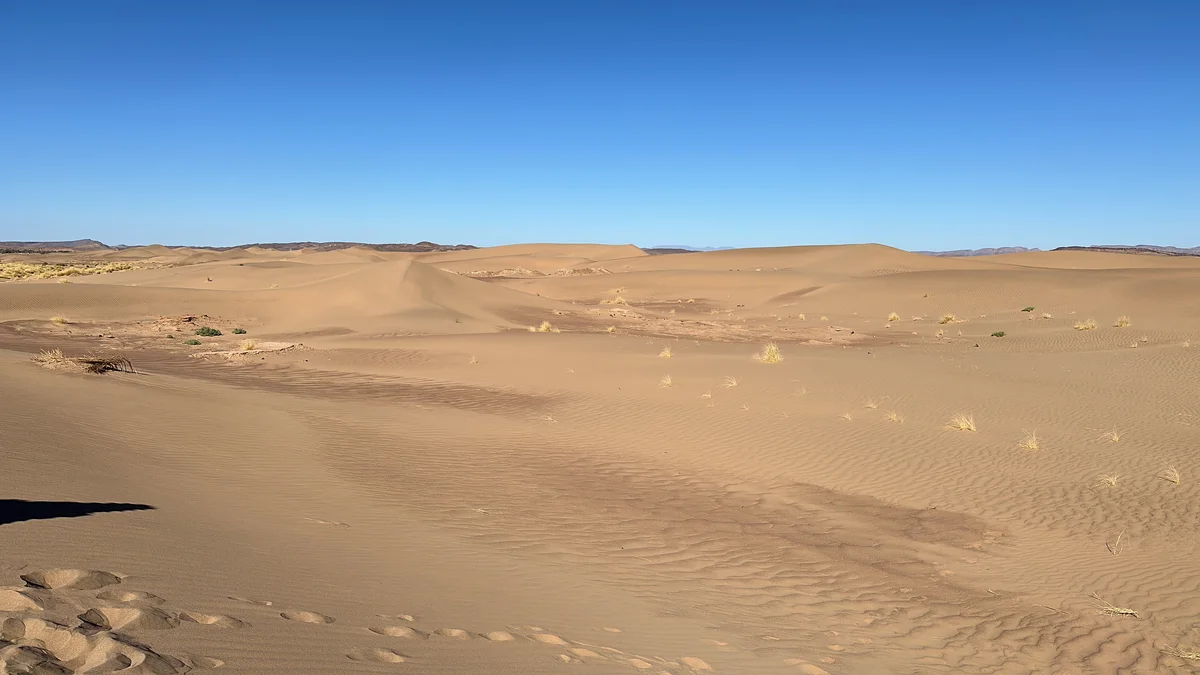
The main reason to come to M'Hamid is Erg Chigaga, a large and remote sea of dunes lying roughly 50-60 km to the west and southwest. It is widely considered one of Morocco's biggest and wildest dune fields, and it sees far fewer visitors than Erg Chebbi near Merzouga.
There is no paved road to Chigaga. You reach it either by camel over several days, or by 4WD along rough off-road tracks crossing stony plains, dry lakebeds and soft sand. The drive typically takes a few hours each way and needs a driver who knows the route, as there are no signposts. Most people overnight at a desert camp among the dunes. The payoff is genuine isolation, vast silence and some of the clearest night skies in the country.
Erg Lehoudi: The Closer Dunes
If you don't have time for the full expedition to Chigaga, the smaller Erg Lehoudi (also written Lihoudi) lies much closer, only a short drive northeast of M'Hamid. These dunes are far more accessible and make a good option for a short overnight or even a sunset camel ride.
Lehoudi is more modest in scale and, being near the village, busier and less wild than Chigaga, but it offers a real taste of the desert without a long off-road journey. It suits travellers who are short on time, on a tighter budget, or simply want a gentler first encounter with the Sahara before deciding whether to venture deeper.
Old Ksour, Oasis and Palm Groves
Around M'Hamid, several old fortified villages, or ksour, reward a slow wander. The nearby Ksar Ouled Driss is among the better-preserved examples, with thick mud walls, watchtowers and shaded covered lanes that speak to centuries of desert-edge life. Some ksour house small private museums of nomadic and Saharan objects.
The palm groves and oasis gardens are worked much as they long have been, with date palms sheltering small plots of cereals and vegetables from the sun. Walking the palmeraie at the cooler ends of the day, between the irrigation channels and mud-brick walls, is one of the simplest pleasures here, and a reminder that this was a living crossroads long before tourism arrived.
Caravan History at the Desert's Edge
M'Hamid's older name is linked to Taragalte, and the village sits on what were once trans-Saharan trade routes. For centuries, caravans rested in the date-palm oases here before, or after, long crossings of the open desert toward the south, carrying salt, goods and stories between the Maghreb and the lands beyond the Sahara.
That history is more atmosphere than monument today, but it shapes how the place feels. The mud architecture, the position at the frontier of cultivated land and dune, and the enduring nomadic and Saharan traditions all trace back to M'Hamid's role as a staging post at the edge of the deep desert. It gives a stop here more depth than the dunes alone.
The Desert Music & Nomad Festival
M'Hamid is home to an annual desert festival, the Festival Taragalte, traditionally held in the dunes near the village, usually in the autumn. Founded by local brothers, it celebrates nomadic heritage, Saharan and Gnawa music, poetry and crafts, drawing local performers alongside national and international artists.
The festival also has a cultural and environmental mission, with programming around nomadic identity and combating desertification. If your visit happens to coincide with it, the dates are worth confirming in advance, as the village fills up and accommodation is in demand. Outside festival time, M'Hamid returns to its usual quiet, which for many is the whole point of coming.
What a Trip Involves
A typical M'Hamid desert trip starts with meeting your guide or driver in the village, then heading out by camel or 4WD. Short options include a sunset ride and one night at a nearby camp; longer trips push out to Erg Chigaga for one or more nights, often combining vehicle transfers with camel sections.
- Bring layers; desert nights are cold even when days are hot.
- Carry plenty of water, sun protection and a headlamp.
- Confirm exactly what your camp and trip include before setting off.
- Phone signal and services are limited once you leave the village.
For the best light and most comfortable temperatures, check our notes on the best time to visit the Sahara and plan around the extreme summer heat.